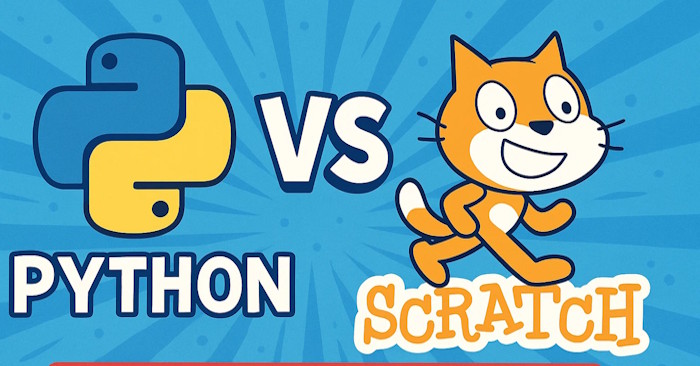
Scratch vs. Python: Which language should children start learning first?

Scratch and Python are two programming languages that are recommended to be taught to children. However, there are still differences between them. So You should let your child learn Scratch or Python first? Let’s find out together!
Scratch is a free block programming language developed by the Scratch Foundation, for children from 8 to over 13 years old; Here, children build programs by putting together command blocks without typing. In contrast, Python is a text-based language used by professional programmers, where every line of command needs to be typed directly. Typically, children do best when they start with Scratch at ages 8–10 and move on to Python around age 11; However, children 11 years old and older who are proficient in typing can start right away with Python.
Is Scratch similar to Python? Are not. These are two separate languages but share the same core ideas: command blocks “repeat” (repeat) in Scratch corresponds to a ` loopfor` in Python, what about the command “set the score to 0” (set score to 0) corresponds to the ` statementscore = 0`. Let’s objectively compare these two languages, put equivalent programs side by side to clearly see the differences and make the best choice for your baby!
Scratch and Python comparison table
| Features | Scratch | Python |
| Language type | Block-based visual programming language | Text-based programming language |
| Difficulty level | Beginner friendly (ideal for ages 6 to 12) | Intermediate level (ideal for ages 10 and up) |
| Language type | Drag and drop blocks of code — no typing required | Requires code entry based on syntax |
| Best for | Children are just starting to learn programming and love visuals. | Children are ready to move on to practical programming |
| Programming concepts | Introduce logic, loops, conditions, and events concepts in a visual way. | In-depth coverage of logic, loops, conditional statements, functions, and data structures. |
| Project type | Games, animations, interactive stories | Games, AI projects, data analysis, web and application development |
| Focus on creativity | Highly creative — focused on storytelling and design. | Have logical thinking and analytical ability – focus on solving problems using a systematic method. |
| Foundation | Runs on the web (no installation required) | Requires an IDE (like IDLE, Thonny or Google Colab) |
| Practical application | Mainly used for learning and educational purposes. | Used in practical programming and professional applications. |
| Learning speed | Easy to learn — intuitive and easy to grasp | It takes time to master — requires an understanding of syntax. |
| Conversion roadmap | Great foundation before moving on to Python or JavaScript. | Used as the next step after Scratch. |
| Community support | Large global community for children (Scratch website) | Huge global developer community (Python.org, Stack Overflow) |
| Interesting fact | High level — colorful, game-style interface helps capture your child’s attention. | Medium level — fewer visual elements, more focus on logical thinking. |
| Example project | Maze game, animation, virtual pet | Calculation tools, chatbots, data visualization tools, mini games |
| Skills development | Creativity, sequence, storytelling, event logic | Problem solving, logical thinking and practical programming |

Should children learn Scratch or Python first?
Based on the above factors, children should learn Scratch first and then Python.
- Children between 6 and 9 years old should start with Scratchbecause command blocks eliminate typing barriers, allowing children to focus on logical thinking. At ages 10 to 12, children who have used Scratch will be ready to move on to learning Python.
- From 13 years old and up, starting right away with Python is a completely reasonable choicebecause at this age, the phase of learning through a visual interface no longer brings significant additional benefits.
- Ages 6 to 9: Definitely start with Scratch. At this age, coding can be a hindrance; Command blocks help children focus on the most important thing: logical thinking. If your child is 5 or 6 years old and can’t read yet, ScratchJr will be a gentler and more suitable starting point.
- Ages 10 to 12: If your child is already familiar with Scratch, this is the ideal time to move on to Python. If your child has never programmed before but is proficient in reading and writing, they can start directly with Python.
- Ages 13 and up: Getting started with Python right away is a perfectly reasonable choice; At this age, transitioning from visual tools no longer brings much added value.
Why does learning Scratch first make learning Python easier later?
Because core programming concepts—like loops, conditional statements, variables, and events—are the same in both languages. Scratch allows children to master these concepts intuitively without being pressured by complex syntax from the beginning. When switching to Python, children already understand the nature of loops and just need to learn how to code it. This is like learning how to think in a language before learning how to write it correctly.



Post Comment